Why a consortium?
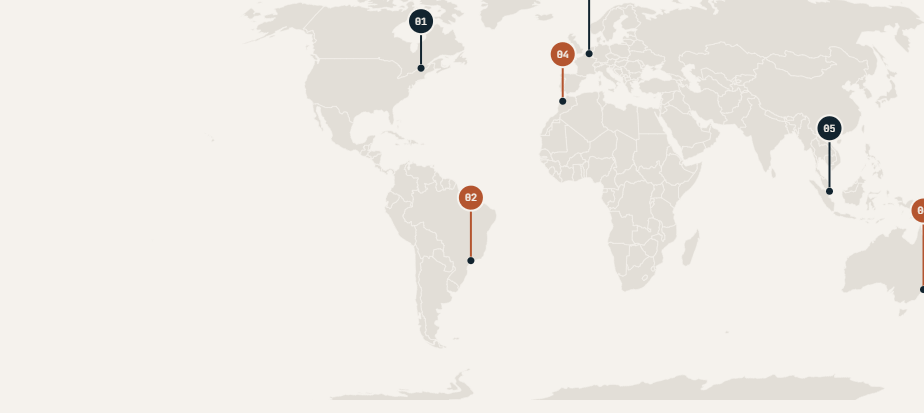
42 companies, several jurisdictions, one shared responsibility.
Pacto lets companies contract with different freelancers under a model in which remuneration can be spread over time and tied to a share of the future revenue generated.
Depending on the terms of each contract, this mechanism can value some missions at up to three times their reference price, while turning an immediate expense into a progressive commitment tied to future value creation.
For the company, it means accessing the skills needed for its growth without immediately bearing the full cost.
For the freelancer, it means taking a more direct part in the value they help create and benefiting from a higher earning potential.
Durability is not proclaimed. It is built.
An innovation meant to produce global change cannot reasonably rest on the continuity of a single legal entity.
A single company can face bankruptcy, dissolution, a change of strategy or a regulatory difficulty. When all the assets and rights depend on that one structure, its disappearance can threaten the whole ecosystem.
The Pacto consortium was created to reduce this dependency and prevent a single company from becoming a central point of failure.

An ecosystem larger than each member
Pacto's continuity does not rest on the survival of one company. The plurality of its co-owners lets the ecosystem keep existing even when a member runs into difficulty.
Spread responsibilities and risks
The presence of several companies across jurisdictions reduces operational and legal concentration. This architecture does not remove every risk, but it strengthens the collective capacity to absorb them.
Balance the decisions
Rights, responsibilities and intellectual property are spread among the consortium members. This organisation favours a plurality of viewpoints, mutual-control mechanisms and long-term-oriented governance.
Think globally, act locally
A global project must understand the economic, cultural and legal realities of the territories where it operates. The consortium's geographic diversity lets Pacto rely on several environments and legal traditions.
Distributed ownership serving a common vision.
The 42 member companies are co-owners of the Pacto ecosystem and co-holders of its rights and intellectual property, under the consortium's founding agreements. This organisation was designed so that the essential elements of the system cannot be conflated with the temporary interests of a single company.
The consortium thus makes it possible to build:
- continuity independent of the fate of any particular entity;
- responsibility spread across several members;
- international representation;
- a better ability to adapt to local contexts;
- governance that protects Pacto's founding mission.
New ideas are often seen as dangerous before they become obvious.
The Overton window describes the space of ideas a society considers, at a given moment, acceptable or conceivable.
Major transformations often start outside this space of familiarity. A new idea can first seem impossible, incomprehensible or risky. It then enters the debate, becomes more intelligible, and can progressively be considered acceptable and, sometimes, obvious.
The Pacto model challenges several established habits: how a mission is financed, the relationship between immediate cost and future revenue, and how value is shared between a company and the freelancers who contribute to its growth.
We knew such a shift could raise questions. So we chose to answer them with a concrete architecture: shared ownership, international governance and a long-term statutory commitment.
The value created must also serve the collective interest.
Pacto believes its success should not be measured by its economic results alone.
Within the consortium it co-founded, Pacto adopted a statutory clause providing that the greater part of the profits generated by its activities be devoted mainly to humanitarian purposes and/or initiatives with a positive impact for humanity.
This commitment gives a lasting direction to the value produced by the ecosystem. It aims to make profit a means of action rather than an isolated end.
Develop
Create an economic model able to generate value durably.
Protect
Preserve Pacto's mission through distributed, international governance.
Redistribute
Devote the greater part of the profits to humanitarian actions or actions positive for humanity, in line with the applicable statutory provisions.
A new infrastructure for a new relationship to work.
Pacto wants to contribute to a world where companies can more easily access the skills they need, where freelancers can be more closely associated with the value they create, and where economic success can fund positive collective impact.
To carry such a broad ambition, we chose a structure to match: international, distributed, resilient and guided by shared responsibility.
Frequently asked questions
Why is Pacto not owned by a single company?
Because full concentration of rights and assets would create dependency on a single entity. The consortium aims to spread this responsibility and strengthen the ecosystem's continuity.
Does the consortium structure remove any risk of shutdown?
No. No structure can remove all risks. Pacto's distributed organisation nevertheless seeks to reduce the risk that a difficulty affecting one company shuts down the whole ecosystem.
Who holds Pacto's rights and intellectual property?
Under the consortium's founding agreements, the 42 member companies are co-owners of the ecosystem and co-holders of the rights and intellectual property concerned.
Why bring together companies from several jurisdictions?
This diversity keeps the whole project from depending on a single legal or economic environment. It also brings a plurality of experience and a better international footing.
How are Pacto's profits used?
A statutory clause provides that the greater part of the profits from Pacto's activities be devoted mainly to humanitarian purposes and/or initiatives positive for humanity, under the terms of the applicable texts.